

The appearance and colour of travertine has great decorative possibilities and applications in interior and exterior design.
Travertine has catapulted as this year’s most coveted trend. In this post you will discover some of its main characteristics and its application possibilities in different spaces. We are sure that you too will fall for this trend that never goes out of fashion.
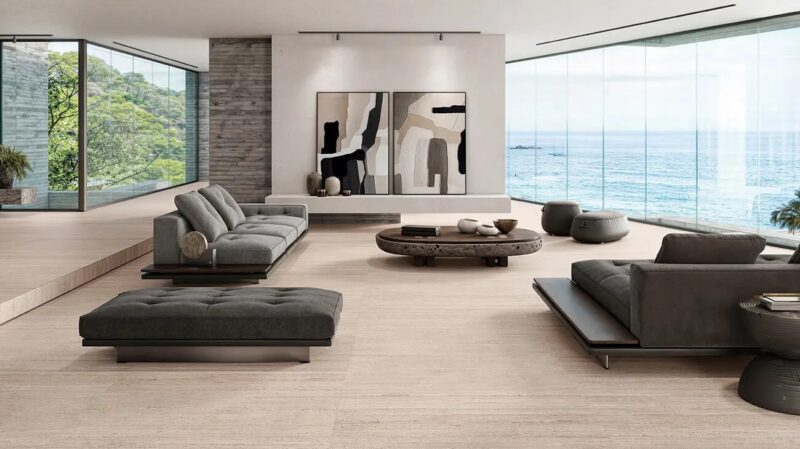
Living room with Taranto Bone flooring (Porcelanosa).
The infallible properties of travertine
Beauty and durability. Travertine is a sedimentary stone formed in thermal waters. Here we explain the properties that make it the most desirable material of 2025.
- Appearance: the texture of travertine has a porous appearance with veins and holes. Porcelanosa’s technology and production innovation allow for a wide range of travertine marble imitation porcelain and travertine tile models. We will discuss them in more detail later on.
- Colour: travertine can be found in various colours. Shades of beige, brown, cream, white or grey. The veins can be darker or lighter, depending on the model.
- Porosity: it is a highly porous stone. The pores can vary in size and quantity, affecting its ability to absorb water and liquids.
Durability: It is a tough and durable stone, especially when used indoors or areas with less exposure to sunlight. Due to its porosity, it is susceptible to damage if exposed to excessive moisture or corrosive chemicals.
- Finishes: travertine can be found in different finishes, such as polished, brushed, honed or bush-hammered.
- Maintenance: L’Antic Colonial travertine requires a certain amount of maintenance to preserve its beauty and resistance. To prevent the penetration of liquids and stains, it must be ensured that the stone is completely sealed. It should be cleaned with products that are not corrosive or acidic.
- Aesthetic appearance: travertine marble has a classic and elegant look, which adds a touch of sophistication to the spaces where it is used. Its natural and warm appearance gives it a timeless style.
Natural beauty in travertine marble types
Travertine, a naturally occurring limestone prized for its rustic and elegant aesthetic, has inspired various interpretations in modern materials such as ceramics, large format porcelain tiles and Undora®, an innovative eco-friendly option.
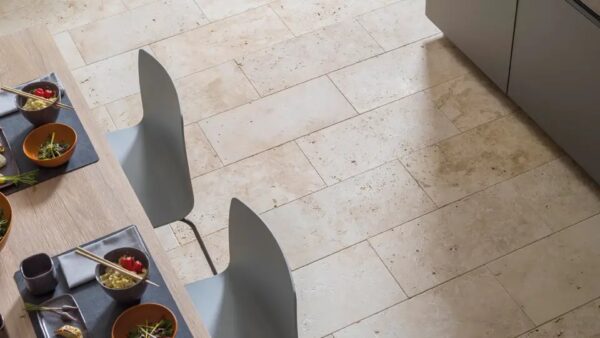
Detail of the Moka Anticato travertine stone floor, by L’ Antic Colonial.
– Travertine stone. This natural material stands out for its porous texture and unique veins, bringing warmth and authenticity to any architectural space. Its timeless aesthetics and resistance make it an ideal choice for cladding, flooring and decorative elements in interiors and exteriors.
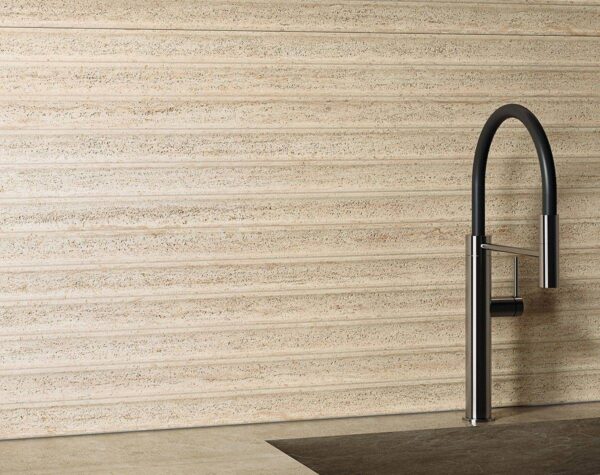
Detail of the Deco Taranto Marfil ceramic wall tile by Porcelanosa.
– Travertine tile. Available in multiple finishes and shades, Porcelanosa’s travertine tile is an ideal alternative for indoor and outdoor environments. Its manufacture makes it possible to reproduce the characteristic veins and pores of travertine, offering an aesthetic solution with greater resistance to humidity and wear.
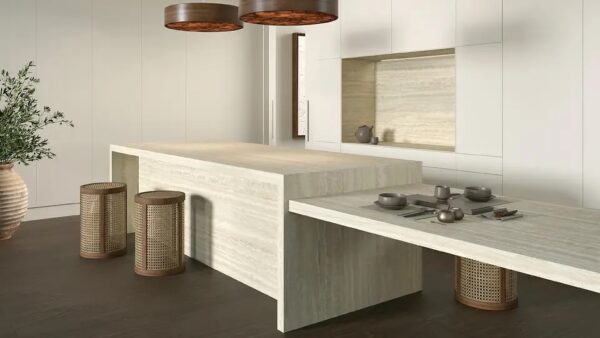
Ambience with XTONE Navona.
– Large format porcelain tile. Imitation travertine marble porcelain is an ideal option for those seeking visual continuity and sophistication in their spaces. Thanks to its low porosity and high resistance, this material is perfect for high traffic areas, facades and bathrooms. Its lightness and large size allow minimising joints, achieving clean and modern surfaces without sacrificing the warmth of natural travertine.
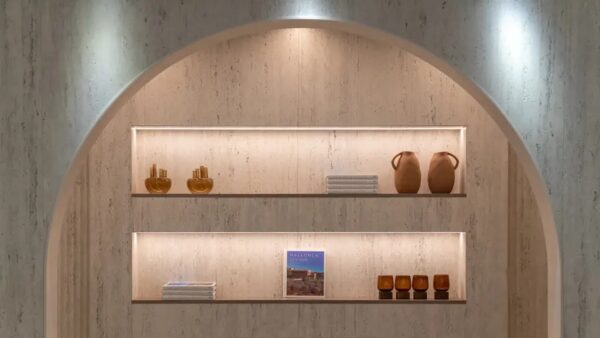
Ambience with Undora® Travertino Albino Romano, by Krion.
– Undora®. This is an innovative material composed of surplus marble and ceramic, a sustainable alternative that emulates the texture and nuances of travertine marble. Its production reduces environmental impact by reusing materials, without compromising durability or aesthetics. Undoubtedly, Krion’s main novelty for this year.
The different uses of travertine
The interior design of spaces that include travertine stone or travertine tiles bring a touch of elegance and sophistication to any space, both indoors and outdoors. Below, we detail the different ways in which travertine marble can be used in rooms:
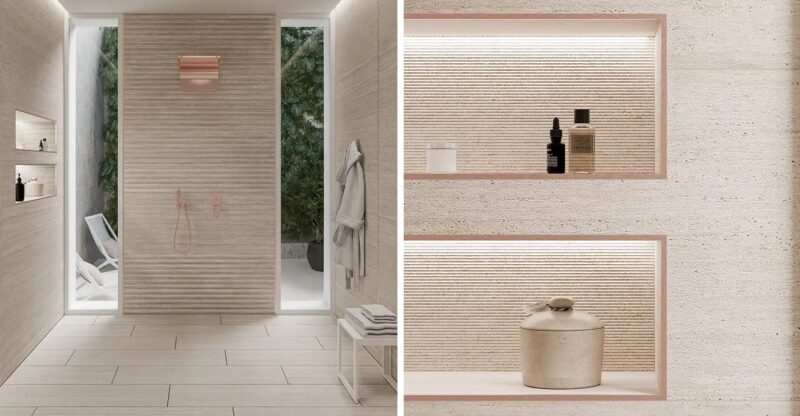
Shower area tiled with the Taranto collection (Porcelanosa), including the invisible shower tray Shower deck n, Pro-part Copper Line profile and the XPS modular niche, by Butech.
– Wall coverings: travertine is used to cover the walls of living rooms, dining rooms, kitchens and bathrooms. It is also a very good idea to integrate it as a bed headboard. The Taranto ceramic collection -inspired by travertine- has different decorations, adding dynamism to the environments.
– Flooring: travertine stone and travertine tile are an excellent choice for flooring. Both are highly resistant and durable to high traffic.
– Countertops: its application as a kitchen or bathroom countertop adds a touch of elegance.
– Fireplaces: cladding a fireplace with travertine helps to create a focal point in rooms such as the living room or dining room. The texture of travertine and its neutral colours beautify spaces.
– Architectural details: it is a good choice to use travertine to highlight architectural elements such as columns, arches or cornices.
– Furniture and accessories: opt for furniture or accessories inspired by travertine, such as side tables, frames or lamp bases. For a more original look, opt for the Slender washbasin which, hand-painted, manages to reflect the aesthetics of natural travertine. Enhancing the beauty of this material, the Butech profiles will add that modern and distinctive touch.
– Exteriors: travertine stone or porcelain imitation travertine marble are good alternatives for paving interior patios or terraces. Their natural aesthetic brings harmony and a Mediterranean touch to the environment.
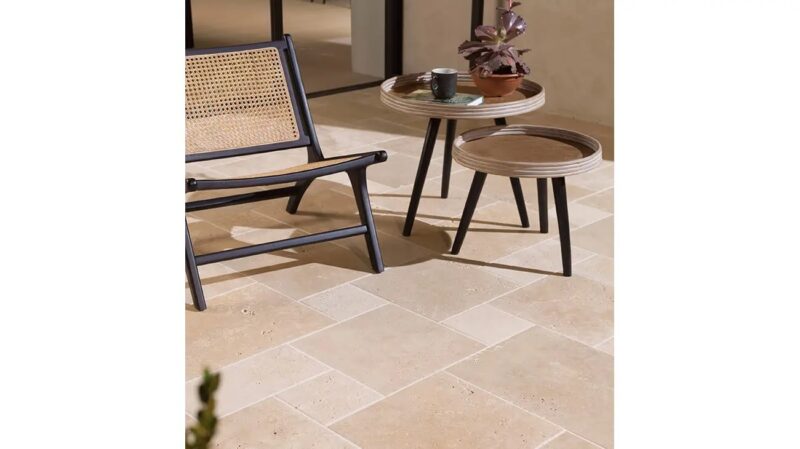
Terrace with Toscano Anticato travertine stone paving, by L’ Antic Colonial.
Decoration with travertine marble
Travertine gives us feelings of serenity, peace and calm. We tell you what three keys are necessary to decorate a space with travertine and how you can do it.
Colours and accessories
– Travertine can be mixed with warm or dark shades.
– Depending on the colours of the textiles and the shapes of the armchairs and sofas, a more classic or contemporary style can be achieved.
– Opt for travertine in beige or golden tones for a warm and cosy atmosphere.
– Use raffia baskets, wicker chairs or hemp lamps for a natural, minimalist look.
– For a travertine kitchen or bathroom, gold or brushed nickel fittings are a good complement.
– Travertine accessories add a touch of distinction to the ambience.
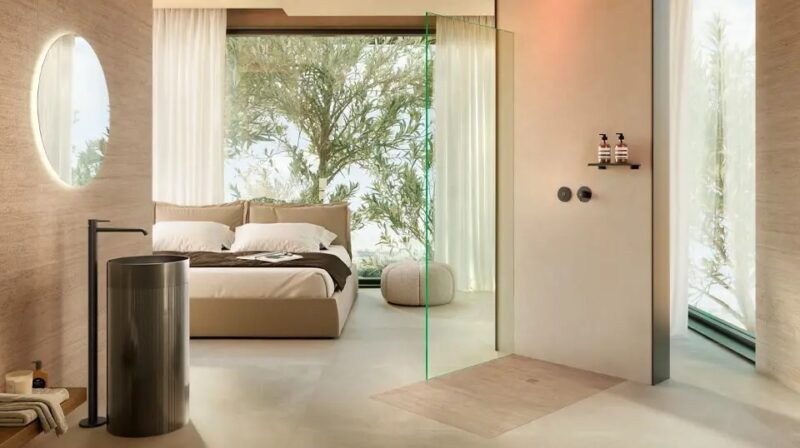
Bathroom with Slate Travertino Marble shower tray, Eye shower head, Rome washbasin and Round taps.
Combination with other materials
– Fuses travertine marble with wood, metal, glass or other types of stone.
– Combine it with concrete or polished cement for a contemporary, industrial look.
– Contrast with textiles, such as linen or velvet, for warmth and sophistication.
Lighting
– Strategic lighting accentuates the beauty of travertine stone or the look of Porcelanosa’s travertine marble-look porcelain tiles.
– Use floor lamps, wall sconces and recessed lighting to highlight the texture of the travertine.
– It integrates recessed spotlights in travertine floors to highlight corridors and exteriors.
– Place LED strips in travertine niches or niches for a sleek, modern effect.
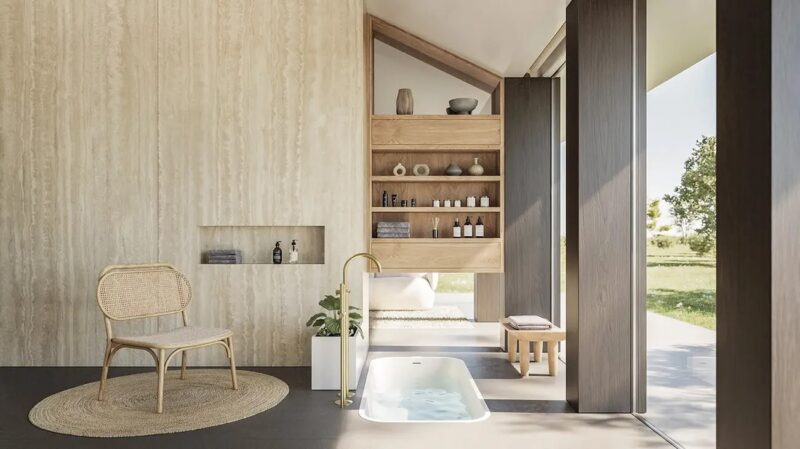
Bathroom including the Navona, Ele and Tadelakt collections by XTONE.
The elegance of travertine
In short, this material is an excellent choice for residential and contract spaces, due to its attractive aesthetics, durability and versatility. It is essential to consider factors such as maintenance and the type of interior design that this material projects. It is important to know the alternatives that exist: porcelain imitation travertine marble and travertine tile.
If you want to see the different models of travertine marble or travertine tile, visit our store.


